.svg)
.png)
.png)
Table of Contents
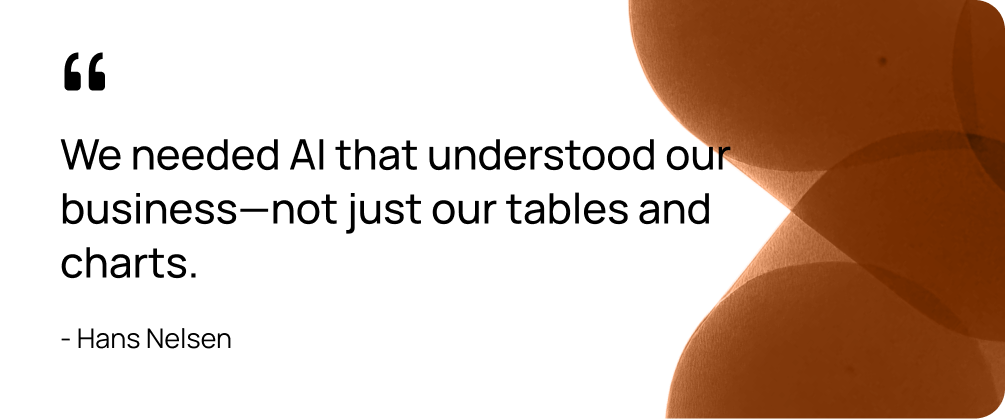
Brightside Health delivers virtual, evidence-based care for anxiety, depression, and related mood disorders. As the company rapidly scaled its patient programs and provider network, its data team needed more than dashboards—they needed AI that understood their business, continuously analyzed performance, and could act on their behalf across activation, retention, and provider experience. Push.ai became that AI-native operating layer, transforming Brightside’s analytics into a living, learning system.
.svg)
Continuous AI-driven monitoring across the full patient journey
.svg)
Improved activation and retention through real-time insight and intervention
.svg)
Lower no-show rates through behavioral pattern detection and workflow automation
Introduction
Brightside Health is a fast-growing virtual mental health provider serving patients nationwide. With programs spanning therapy, psychiatry, IOP, teen care, and crisis-adjacent support, Brightside needed analytics capable of keeping up with clinical complexity and operational scale.
As SVP of Data, Hans Nelsen was responsible for ensuring data consistently translated into better outcomes. Tableau provided core reporting, but answering “why is this happening?” required manual, time-intensive deep dives across multiple dashboards and teams.
Push.ai introduced an AI-native layer that understands Brightside’s business context, continuously analyzes performance trends, and drives intelligent actions that improve both patient and provider outcomes.
Company Background
Brightside Health (250–500 employees) delivers evidence-based mental health care virtually, offering therapy, psychiatry, and specialized programs for teens and individuals at elevated suicide risk. Appointments are available within days, and services are covered by major insurers—making Brightside a key access point for high-quality care across the U.S.
Their mission: deliver life-changing care across the full spectrum of severity, including complex and crisis-adjacent cases. Achieving this at scale requires precise, real-time insight into patient journeys, provider performance, and operational signals.
.png)
Challenges
Despite a solid BI foundation, Brightside faced scaling challenges familiar to modern healthcare organizations:
- Time-consuming analysis
Understanding why activation, retention, or provider metrics shifted required manual deep dives into Tableau across multiple reports. - Limited automation
Insights didn’t flow directly into operational tools—teams manually created follow-ups, coaching tasks, or patient outreach steps. - Ballooning complexity
As Brightside expanded programs, conditions, and partner networks, the number of segments and metrics outgrew what dashboards could meaningfully represent.
Hans needed a system where AI could:
- Understand Brightside’s business context
- Continuously analyze performance
- Surface issues before monthly reviews
- Take direct action across tools like Asana
Push.ai was the first platform capable of delivering all four.
Solution
Push.ai introduced a Business Graph™ tailored to Brightside’s mental health operations—a unified, AI-ready representation of patients, providers, appointments, communications, and outcomes.
- A Business Graph Built for Action
Push incorporated Brightside’s existing metrics, dimensions, and relationships into a contextual graph that combines structured data with unstructured context (documents, messages, notes).
Push then layered AI agents on top to analyze:- What’s happening
- Why it’s happening
- What should be done next
- Modeling the Patient Journey
Push helped Brightside map:- The full journey from sign-up → assessment → first session → ongoing engagement
- Provider signals like responsiveness, follow-ups, and outcomes
- Operational events including cancellations, appointment patterns, and no-shows
- What Previously Required Manual Analysis Became Automated Insight
Push’s AI autonomously:- Identifies drop-off points in activation and retention
- Uncovers patterns behind no-shows
- Surfaces coaching opportunities for providers
This shifted Brightside from reactive analysis to proactive optimization.
Key Results
Brightside realized immediate and sustained improvements:
- Richer, faster insight
Push turned underlying data into continuous explanations—not static dashboards. - Improved activation & retention
Push.ai surfaced root causes, trends, and anomalies without hours of SQL, AI agents identified friction points in onboarding and early engagement, enabling targeted interventions. - Lower no-show rates
Push surfaced patterns in attendance and automated workflows that reduced missed appointments. - Stronger provider coaching
Push automatically created Asana tasks for underperforming providers, including context and recommended actions. - High-leverage data team
Hans’s team now focuses on shaping the Business Graph instead of answering ad-hoc questions.
Implementation
Brightside’s rollout occurred in three major phases:
- Phase 1 — Model the Business Graph
- Integrate existing data stack and semantic layer
- Map the patient journey, provider signals, and operational events
- Combine structured metrics with unstructured context
- Phase 2 — Automate Insight Generation
Push continuously:- Analyzes funnels
- Surfaces behavioral patterns
- Highlights operational risks
- Delivers context-aware insight feeds to teams
- Phase 3 — Drive Intelligent Actions Across Tools
1. Activation & Retention Interventions
Push monitors segments, identifies cohorts with low activation, and triggers targeted workflows.
2. No-Show Reduction
AI learns patterns in attendance and informs automated workflows to improve show rates.
3. Provider Coaching via Asana
Push creates tasks for operations and clinical leaders when underperformance patterns emerge—turning intermittent coaching into continuous improvement.
.png)
Business Outcomes
- An AI-Native Operating Layer
Analytics evolved from something teams “look at” to something that constantly works on their behalf. - Improved patient journey performance
With better insight into activation, engagement, and retention, more patients successfully navigate early and ongoing care. - Reduced no-show rates
AI-driven patterns and workflows protect provider schedules and patient outcomes. - Data-backed provider performance management
Automatic coaching tasks create more consistent and equitable support for providers. - Data team leverage at scale
Hans’s team now operates as designers of the system—not manual explainers of data. - Future Expansion
Brightside is extending its Business Graph to new service lines and exploring additional AI-driven workflows for:- Patient communications
- Partner reporting
- Capacity planning
Push constantly asks: What’s happening? Why? And what should we do next?


Join the Push.ai Open Beta
Sign up to start sharing your metrics and keep you teams informed with relevant data today!